Anatomy of the Balancer V2 ComposableStablePool Hack (Nov 2025)
TL;DR — On 2025-11-03 07:46:47 UTC, a single contract-deployment transaction drained two Balancer V2 ComposableStablePools of ≈19,239 ETH (${\approx $71\text{M}}$ at the Chainlink spot of $$3{,}709.52$). The constructor fired a
batchSwapof 226 swaps that resolved into three phases: a geometric BPT-exit cascade, a WETH↔osETH ping-pong that drives a token balance into the sub-100-wei regime, and a geometric BPT-mint cascade that re-mints the BPT for ~2.5% of fair value. The root cause is a rounding inconsistency between the rate-based balance scaling (mulDown, floor division) and the invariant $D$ recomputation at high amplification. Every number below is read directly from mainnet withcast.
The evidence, verified on-chain
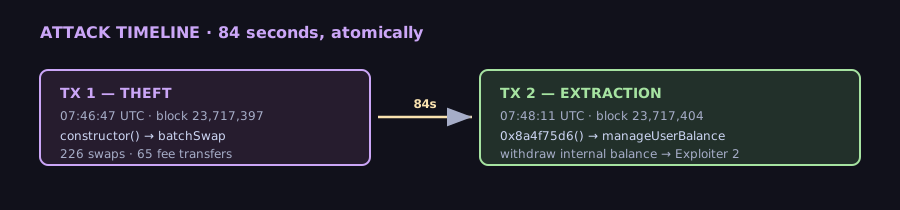
| Theft tx | 0x6ed07db1…23bc9742 — block 23,717,397, 07:46:47 UTC, status ✅ |
| Extraction tx | 0xd1552072…5b48569 — block 23,717,404, 07:48:11 UTC (84 s later) |
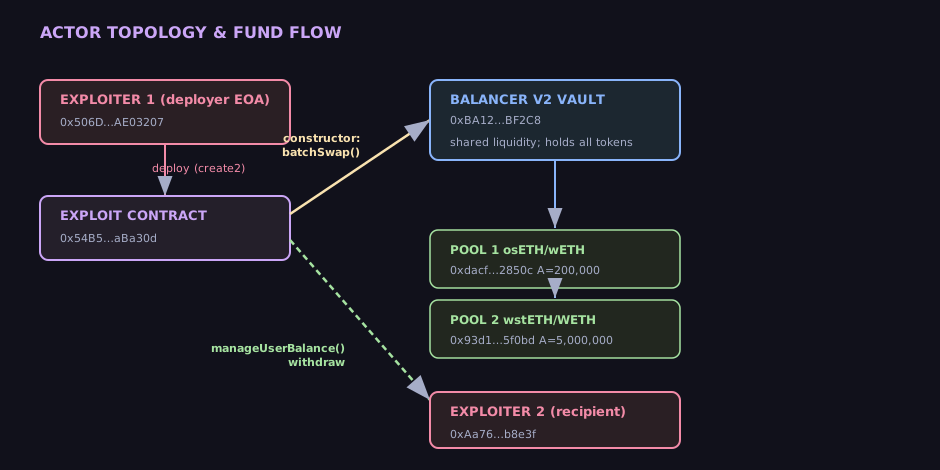
| Exploit contract | 0x54B53503c0e2173Df29f8da735fBd45Ee8aBa30d |
| Deployer (EOA) | 0x506D1f9EFe24f0d47853aDca907EB8d89AE03207 |
| Recipient (EOA) | 0xAa760D53541d8390074c61DEFeaba314675b8e3f |
| Pool 1 | 0xdacf5fa1…2850c — osETH/wETH StablePool, $A = 200{,}000$ |
| Pool 2 | 0x93d19926…5f0bd — wstETH/WETH StablePool, $A = 5{,}000{,}000$ |
| Swap events in tx1 | 226 (121 on pool 1, 105 on pool 2) |
| Fee transfers | 65 (to the Protocol Fees Collector) |
| Net stolen | 6,587 WETH + 6,851 osETH + 4,260 wstETH (+ 64.6 BPT scraps) |
Reproduce the headline figures yourself:
RPC=https://ethereum.publicnode.com
# both transactions succeeded
cast receipt 0x6ed07db1a9fe5c0794d44cd36081d6a6df103fab868cdd75d581e3bd23bc9742 \
  --rpc-url $RPC | grep status      # -> 1
# the two pools
cast call 0xdacf5fa19b1f720111609043ac67a9818262850c "name()(string)" --rpc-url $RPC
# -> "Balancer osETH/wETH StablePool"
# ETH spot price at the attack block (Chainlink ETH/USD, 8 decimals)
cast call 0x5f4eC3Df9cbd43714FE2740f5E3616155c5b8419 \
  "latestRoundData()(uint80,int256,uint256,uint256,uint80)" \
  --block 23717397 --rpc-url $RPC   # answer 370951870300 -> $3,709.52
Background: the Vault and "composable" pools
Balancer V2 centralizes all token custody in a single Vault (0xBA12…BF2C8). Pools are stateless pricing modules; the Vault moves the bytes. Two design choices matter here.
Internal balance. The Vault credits each account a per-token internal balance. A batchSwap settles net deltas against internal balance at the end — so a contract can trade in circles and walk away with the net surplus, never touching ERC-20 transfer until it withdraws.
Composable pools. A ComposableStablePool lists its own BPT as one of the pool's tokens. Joining/leaving is expressed as ordinary swaps against BPT, and the BPT "price" is derived from the invariant $D$:
$$\text{BPT rate} ;=; \frac{D}{\text{totalSupply}}$$
Both targeted pools are 3-token composable stables whose non-BPT tokens are liquid-staking derivatives (LSDs) carrying an exchange rate $> 1$:
| Pool | Tokens | Rate-bearing token | Scaling factor (on-chain) |
|---|---|---|---|
| osETH/wETH | WETH, BPT, osETH | osETH | 1.073369637857500505e18 |
| wstETH/WETH | wstETH, BPT, WETH | wstETH | 1.239655095734259789e18 |
The vulnerability: mulDown eats precision
Before the invariant runs, balances are upscaled by their scaling factor so rate-bearing tokens enter the math at true ETH parity:
// Balancer FixedPoint — rounds DOWN
function mulDown(uint256 a, uint256 b) internal pure returns (uint256) {
    return (a * b) / ONE;          // ONE = 1e18
}
// upscale path (simplified)
balances[i] = mulDown(balances[i], scalingFactors[i]);
For an 18-decimal token with no rate, scalingFactor = 1e18 and mulDown(b, 1e18) = b — exact, zero loss. But osETH's factor is 1.07337e18. There, floor division discards a fraction of a wei:
$$\tilde b ;=; \text{mulDown}(b,, f) ;=; \left\lfloor \frac{b \cdot f}{10^{18}} \right\rfloor, \qquad f_{\text{osETH}} = 1.073369637857500505 \cdot 10^{18}$$
For a large balance this is rounding noise. For a balance of a few wei it is a 6–7% relative distortion:
| $b$ (wei) | $\lfloor b f /10^{18}\rfloor$ | true $bf/10^{18}$ | rel. loss |
|---|---|---|---|
| 1 | 1 | 1.0734 | 7.34% |
| 8 | 8 | 8.5870 | 6.83% |
| 9 | 9 | 9.6603 | 6.83% |
| 17 | 18 | 18.2473 | 1.36% |
| 69 | 74 | 74.0625 | 0.08% |
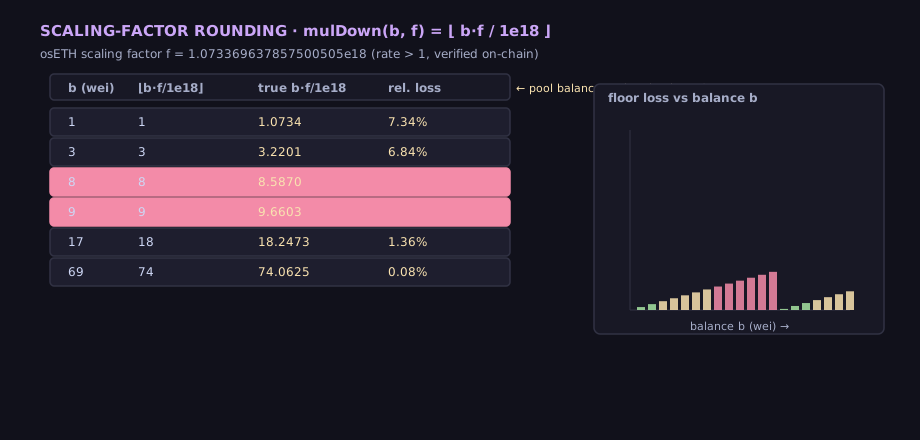
A 7% distortion on 8 wei is still 8 wei — negligible against a multi-million-ETH $D$ if the invariant were well-conditioned. It is not.
Why the distortion becomes catastrophic: amplification
ComposableStablePools price with the Curve-style invariant. With amplification $\mathcal{A}$ and $n$ tokens, $D$ satisfies:
$$\mathcal{A} n^{n} \sum_{i} x_i ;+; D ;=; \mathcal{A} n^{n} D ;+; \frac{D^{,n+1}}{n^{n}\prod_{i} x_i}$$
solved by Newton iteration. Two facts conspire:
- High $\mathcal{A}$ flattens the curve. As $\mathcal{A} \to \infty$, the surface approaches the hyperplane $D \approx \sum x_i$ and the iteration becomes increasingly sensitive to the smallest balances.
- A near-zero balance is a singularity. The term $D^{,n+1}/\prod x_i$ blows up as any $x_i \to 0$. With one balance pinned at a handful of wei and a 7% upscale rounding error layered on top, the iteration converges to a $D$ that systematically understates the true pool value — and therefore understates the BPT rate $D/\text{supply}$.
The pool recomputes $D$ fresh on every swap. So the attack is not "steal 7% of 8 wei" — it is "drive a balance into the ill-conditioned regime, then trade against a BPT price computed from a broken $D$."
Forensic reconstruction: the 226 swaps
Decoding the Swap events of tx1 reveals the constructor did not run "65 identical cycles." It ran a precise three-phase program per pool. Pool 1 (121 swaps):
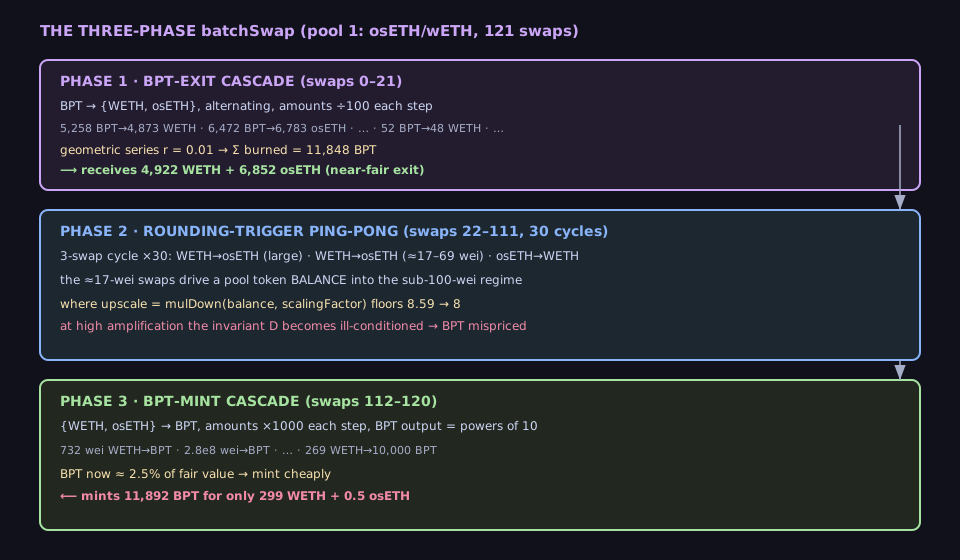
Phase 1 — BPT-exit cascade (swaps 0–21). Twenty-two swaps, alternating BPT→WETH and BPT→osETH, each ÷100 of the previous in its series:
$$5{,}258.03 \xrightarrow{\div100} 52.58 \xrightarrow{\div100} 0.526 \xrightarrow{\div100} \cdots$$
A geometric series with ratio $r = 0.01$. Sum burned:
$$\sum_{k=0}^{10} a,r^{k} = \frac{a}{1-r},\qquad a_{\text{WETH}} = 5258.03,;; a_{\text{osETH}} = 6472.01$$
$$\Rightarrow \text{BPT burned} \approx \frac{5258.03 + 6472.01}{0.99} \approx 11{,}848 \text{ BPT}$$
In return the contract receives 4,922 WETH + 6,852 osETH — a near-fair exit at the pre-distortion BPT rate (≈ 1 ETH/BPT). This is the "loan": real value pulled out of the pool.
Phase 2 — rounding-trigger ping-pong (swaps 22–111). Thirty repetitions of a 3-swap cycle: WETH→osETH (large), WETH→osETH (≈ 17–69 wei), osETH→WETH. The micro-swap is the scalpel — 31 of them land at exactly 17 wei of osETH output, nudging the pool's osETH balance into the sub-100-wei zone where the upscale floor and the singularity collude.
Phase 3 — BPT-mint cascade (swaps 112–120). Nine swaps, {WETH,osETH}→BPT, outputs being exact powers of ten (1e4, 1e7, …, 1e22 wei of BPT), each step ×1000. BPT is now priced from the broken $D$:
$$\frac{\text{underlying paid}}{\text{BPT minted}} ;\xrightarrow{\text{phase 3}}; \approx 0.025;\text{ETH/BPT} \quad\text{vs.}\quad \underbrace{\approx 1.04;\text{ETH/BPT}}_{\text{phase 1 rate}} ;; (\approx 41\times \text{ collapse})$$
The contract re-mints 11,892 BPT for only 299 WETH + 0.46 osETH — roughly 2.5% of the Phase-1 rate. The geometric exit of Phase 1 is "repaid" with a near-free geometric mint of Phase 3.
Net. BPT is roughly flat ($-44$ BPT), but the underlying from Phase 1 is never returned:
$$\underbrace{4{,}922\text{ WETH} + 6{,}852\text{ osETH}}{\text{phase 1 (taken)}} ;-; \underbrace{299\text{ WETH} + 0.5\text{ osETH}}{\text{phase 3 (paid)}} ;=; 4{,}623\text{ WETH} + 6{,}851\text{ osETH}$$
Pool 2 (wstETH/WETH, 105 swaps) repeats the same program, yielding 1,964 WETH + 4,260 wstETH. The accounting closes exactly against the InternalBalanceChanged events.
The exploit contract
The deployed bytecode decompiled (via heimdall-rs) to a contract with two entry points and a constructor that does all the stealing:
- Constructor — builds the
batchSwapcalldata in memory (the 226 steps are computed, not stored literally) and callsvault.batchSwap(...)against both pools, crediting the surplus to its own internal balance. 0x8a4f75d6— the withdrawal. Gated byrequire(msg.sender == _owner), it iterates the target pools, readsgetInternalBalance, and pushes everything to the recipient viamanageUserBalance:
// decompiled & cleaned — selector 0x8a4f75d6(address[] pools)
require(msg.sender == _owner);
for (pool in pools) {
    (tokens,) = vault.getPoolTokens(pool.getPoolId());
    bals = vault.getInternalBalance(address(this), tokens);
    ops = [UserBalanceOp(WITHDRAW, tok, bal, this, RECIPIENT) for ...];
    vault.manageUserBalance(ops);
}
The tx2 calldata confirms it verbatim — selector 0x8a4f75d6 followed by the two pool addresses:
0x8a4f75d6
  0000...0020                                  // offset
  0000...0002                                  // array length = 2
  dacf5fa19b1f720111609043ac67a9818262850c     // pool 1
  93d199263632a4ef4bb438f1feb99e57b4b5f0bd     // pool 2
The constructor is the entire attack surface. No privileged function, no re-entrancy, no oracle manipulation — pure arithmetic, committed in the deploy transaction.
The loot
Reading the six InternalBalanceChanged(address,address,int256) events (topic 0x18e1ea41…) of tx1:
| Pool | Token | Δ (exact) |
|---|---|---|
| osETH/wETH | WETH | +4,623.6015 |
| osETH/wETH | osETH | +6,851.1230 |
| wstETH/WETH | WETH | +1,963.8388 |
| wstETH/WETH | wstETH | +4,259.8435 |
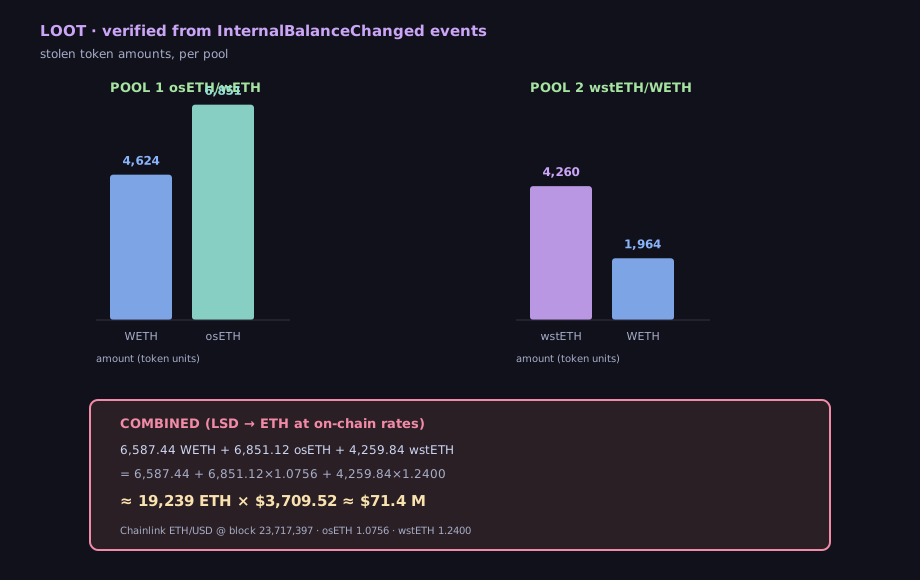
Converting the LSDs to ETH at their on-chain rates ($1.0756$ for osETH, $1.2400$ for wstETH):
$$6{,}587.44 ;+; 6{,}851.12 \times 1.0756 ;+; 4{,}259.84 \times 1.2400 ;\approx; 19{,}239 \text{ ETH}$$
At the Chainlink spot of $$3{,}709.52$/ETH that is ≈ $71M. (Press coverage rounded to ~$63M using face-value LSD accounting and a slightly lower ETH print.)
Why audits missed it
The bug is invisible to every test that checks a swap in isolation — a single swap's rounding is sub-wei and within tolerance. It only manifests as a cumulative, adversarial state trajectory: a balance driven to the ill-conditioned boundary and then a swap priced off the resulting $D$. Three blind spots aligned:
- Unit tests check correctness, not trajectory. "Does
onSwapreturn the right amount for these balances?" passes. "Can a 226-step adversarialbatchSwapdrive $D$ off-conservation?" is never asked. - Amplification is treated as a tuning knob. High $\mathcal{A}$ feels safer ("tighter peg") but sharpens the singularity at $x_i \to 0$.
- The composable BPT makes joins/exits cheap to spin. Flash-exit → distort → flash-mint is a one-transaction round trip with no capital requirement.
The honest fix is not "round more carefully" — it is to assert invariant conservation after every swap and revert if $D$ moves outside a tolerance band, plus bounds-check minimum balances before the Newton loop.
Reproduce everything
RPC=https://ethereum.publicnode.com
# 1. confirm the contract exists and is the attacker
cast code 0x54B53503c0e2173Df29f8da735fBd45Ee8aBa30d --rpc-url $RPC | wc -c
# 2. scaling factors (the rounding source)
cast call 0xdacf5fa19b1f720111609043ac67a9818262850c \
  "getScalingFactors()(uint256[])" --rpc-url $RPC
# 3. amplification
cast call 0xdacf5fa19b1f720111609043ac67a9818262850c \
  "getAmplificationParameter()" --rpc-url $RPC
# 4. the stolen amounts — decode the receipt logs
cast receipt 0x6ed07db1a9fe5c0794d44cd36081d6a6df103fab868cdd75d581e3bd23bc9742 \
  --rpc-url $RPC
# 5. decompile the bytecode yourself
cast code 0x54B53503c0e2173Df29f8da735fBd45Ee8aBa30d --rpc-url $RPC > exploit.hex
asm_to_sol exploit.hex
The exploit is a masterclass in small-errors-compounding: a 7% rounding on 8 wei, amplified by a flat-curve singularity, repeated atomically until a $D$ that is "close enough" per-swap becomes catastrophically wrong in aggregate. The contract did nothing illegal — it called public, audited functions, in the order they were designed for, with parameters they were designed to accept. The math did the rest.